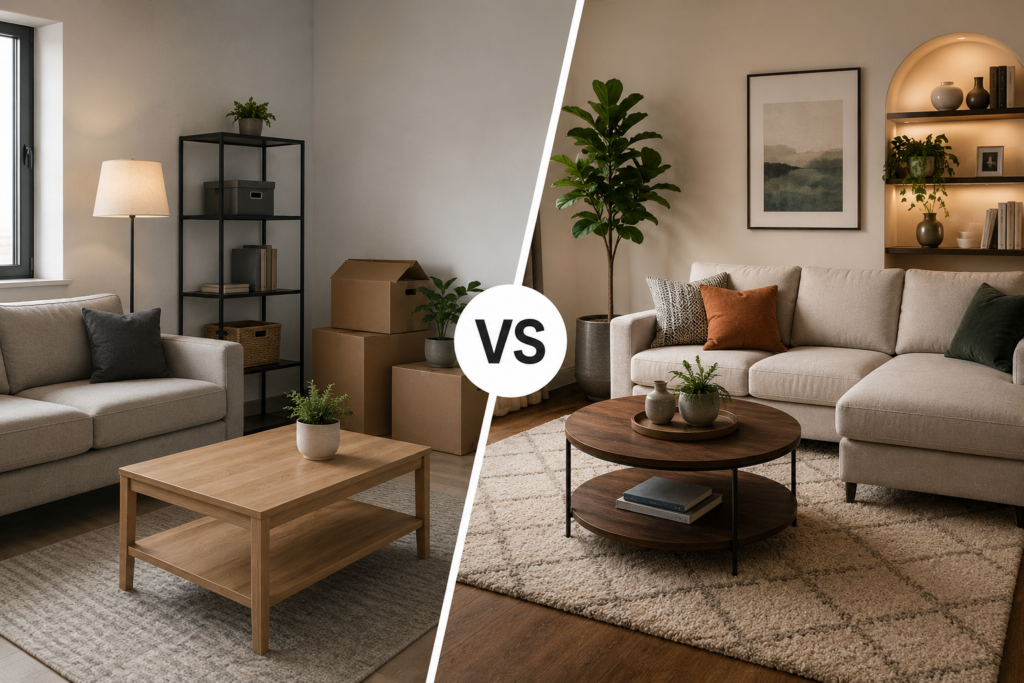
The renting vs buying furniture decision is more nuanced than most apartment dwellers initially assume. According to the American Furniture Manufacturers Association’s consumer research on furniture purchasing patterns, the average American household spends between $2,000 and $5,000 furnishing a new apartment — a significant upfront financial commitment that furniture rental services specifically designed to spread or eliminate this barrier have responded to with growing service availability and improving quality in recent years.
For most people, the instinctive answer to the renting vs buying furniture question is buying — ownership feels more permanent, more sensible, more adult. But for a meaningful segment of apartment dwellers in specific life situations, furniture rental is not just a reasonable alternative to buying. It is the genuinely smarter financial decision.
This comparison does not make a universal recommendation because there is not one. The right answer depends on how long you plan to stay in your current apartment, what stage of life you are in, what your financial priorities are, and how much moving flexibility matters to you. Here is the honest breakdown of both options so you can make the decision that actually makes sense for your specific situation.
Understanding the Furniture Rental Market in 2026
Furniture rental has evolved significantly from its historical reputation as an expensive option for people who could not afford to buy — the rent-to-own stores in strip malls with unfavorable terms that made the total payment far exceed the retail cost of the furniture itself. The contemporary furniture rental market includes a broader range of services and business models than this historical reputation suggests.
Traditional furniture rental through companies like CORT and Rent-A-Center provides month-to-month access to furnished spaces for a monthly fee. These services are particularly well-established for corporate relocation clients and short-term apartment needs.
Furniture subscription services are newer entrants that operate on a subscription model similar to software subscriptions — you pay a monthly fee for furniture packages with options to swap pieces, return items, or purchase at the end of the subscription if desired. Fernish and Feather are examples of this newer model.
Rent-to-own arrangements are what most people historically associated with furniture rental — monthly payments that build toward eventual ownership at terms that are sometimes favorable and sometimes not, depending on the specific retailer and contract.
Corporate housing and serviced apartments come pre-furnished as part of the accommodation package, which is technically the rental model applied to the complete living experience rather than furniture specifically.
Understanding which model is under consideration matters for the comparison because the economics of traditional rental, subscription models, and rent-to-own arrangements are meaningfully different from each other.
Renting vs Buying Furniture — Thoughtful comparisons
1. The Financial Comparison — What Does Each Actually Cost?
This is the heart of the comparison for most people, and the honest answer is that it depends entirely on how long you stay.
The economics of buying furniture
When you buy furniture, you pay the full cost upfront (or on a credit arrangement) and own the item indefinitely. The cost is front-loaded but the ongoing cost is zero — your sofa costs the same per month whether you own it for one year or ten years. The longer you keep the furniture, the lower the effective monthly cost becomes.
A decent sofa costs $500 to $1,500. A basic bedroom set costs $800 to $2,000. A complete apartment furnishing for a one-bedroom space — sofa, bed, desk, dining table, and essential storage — can be achieved for $2,000 to $5,000 with quality budget-conscious choices, or significantly more for premium furniture.
The financial risk of buying is that furniture loses value rapidly — second-hand furniture typically sells for 10 to 30 percent of its original purchase price, and moving furniture long distances costs money in transport or requires the cost of selling and repurchasing at the destination.
The economics of renting furniture
Monthly furniture rental costs vary significantly by market, quality level, and what is included. Basic furnished one-bedroom packages from established rental services typically run $200 to $400 per month for the furniture alone. Premium furnished packages with higher-quality pieces can run $500 to $800 per month.
Over twelve months, $300 per month is $3,600 — within the range of what it would cost to buy equivalent furniture outright. Over 24 months, $300 per month is $7,200 — significantly more than the furniture is worth to buy, and the renter owns nothing at the end.
The break-even point — where renting becomes more expensive than buying would have been — falls somewhere between 12 and 24 months for most furniture rental arrangements. Before this break-even point, renting may be cheaper or comparable. After it, buying is almost always the better financial decision.
a. When Renting Furniture Makes Financial Sense
Despite the math that favors buying in the medium and long term, there are specific situations where furniture rental is the genuinely smarter financial choice.
Short-term stays of 12 months or less — The executive on a 6-month project assignment, the student completing a one-year course, the professional in a temporary corporate relocation, the person in between homes during a transition period. For these situations, buying furniture that then needs to be sold, donated, or moved is frequently more expensive and more complicated than renting comparable furniture for the duration.
Geographic uncertainty — The professional who knows their current role may relocate within the next 12 to 24 months but is not certain when. Moving furniture long distances is expensive — professional movers charge per pound and per mile, and a full apartment’s worth of furniture adds significant cost and complexity to an interstate or international move. Furniture that can simply be returned to the rental company at the end of the lease removes this uncertainty completely.
Limited upfront capital — Someone establishing their first apartment who needs to preserve capital for an emergency fund, career investment, or other financial priority may find the lower upfront cost of rental preferable to the significant lump sum that purchasing requires, even if the total cost over time is higher.
Lifestyle flexibility priority — Someone who moves frequently by choice — the urban nomad who enjoys living in different cities, the person who downsizes seasonally, the professional whose role regularly requires relocation — may value the flexibility that furniture rental provides over the financial optimization that buying and selling would require with each move.
b. When Buying Furniture Makes More Sense
For most apartment dwellers in most situations, buying furniture is the smarter financial and practical decision. Here is specifically when buying clearly wins.
Stays of 18 months or more — Once you are beyond the rental break-even window, buying furniture almost always costs less in total than renting equivalent quality for the same period, even accounting for the value loss on eventual sale.
Established residence — If you have been in your current city for several years and do not anticipate relocating, buying quality furniture that you will own for years or decades produces the lowest lifetime cost per month of any furnishing option available.
Quality preference — The furniture available for rental within standard rental price points tends to be functional and presentable rather than particularly high quality or distinctive in character. Buying allows investment in pieces of specific quality, design, and character that rental inventories rarely include — the vintage piece you love, the specific sofa in the right color for your space, the dining table that is exactly the right size for your apartment.
Building toward ownership — For apartment dwellers who plan to transition to home ownership within a few years, buying furniture now that will move into the purchased home is financially sensible — the furniture cost is a one-time investment that serves both the apartment and the eventual home rather than a recurring monthly cost that ends at lease termination.

2. The Convenience and Flexibility Comparison
Beyond the financial comparison, the renting vs buying furniture decision involves significant practical differences in convenience and lifestyle flexibility that the pure financial comparison does not capture.
Furniture rental convenience advantages:
Delivery and setup are typically included in rental services — the furniture arrives assembled and positioned without the assembly effort that flat-pack furniture requires. Damage and wear are typically covered by the rental service within normal use parameters — a damaged sofa does not become an expensive repair or replacement bill for the renter. Moving out means simply scheduling a furniture collection rather than the selling-donating-moving logistics that owned furniture requires at the end of a tenancy.
Furniture ownership convenience advantages:
You choose exactly what you want — the specific sofa, table, and bed that suits your aesthetic preferences and functional requirements without being limited to the rental company’s inventory. You are not accountable to a rental company for how you use your own furniture — hosting the dinner party that might result in a wine spill, letting pets on the sofa, or using furniture in unconventional ways without worrying about rental agreement damage terms. And you own something at the end — assets rather than the receipts for a service that produced no lasting value.
For apartment dwellers who want maximum flexibility and minimum moving complexity, rental wins on convenience. For apartment dwellers who want complete autonomy over their living space’s character and contents, ownership wins.
The Quality Question
One honest limitation of furniture rental is that rental inventory quality is typically standardized for durability and neutrality rather than optimized for design distinction or premium material quality. Rental furniture needs to be functional across many different renters, hold up to varied use patterns, and be neutral enough to work in diverse apartment aesthetics. This produces furniture that is decent but rarely exceptional.
Buying allows access to any point on the quality spectrum — from budget flat-pack through mid-range quality pieces to premium furniture investments that last decades. The specific character, design, and quality that makes a space feel genuinely personal rather than like a furnished hotel room is more achievable through ownership than rental for most people.
For apartment dwellers who care deeply about the character of their living space, this quality and character distinction is often the most compelling reason to buy rather than rent regardless of the financial comparison.
The Practical Decision Framework
Three questions that determine the right answer for your specific situation:
How long will you be in this apartment? If the honest answer is less than 12 months, lean toward rental. If 12 to 24 months, do the specific math for your market. If more than 24 months, buy.
How important is geographic flexibility? If you might need to relocate with short notice and want zero moving furniture logistics, rental provides this freedom. If your roots are established and moving is not anticipated, this consideration is irrelevant.
What is your financial situation? If upfront capital is constrained and preserving cash matters more than long-term cost optimization, rental is viable. If the upfront investment is manageable and long-term cost matters most, buying wins financially.
For apartment dwellers who decide to buy rather than rent but want maximum flexibility from their furniture investment check out our complete guide to the best foldable furniture for small apartments — the multi-function and space-saving pieces that maximize flexibility and storage within the furniture you own.
Whether you rent or buy your furniture the decoration choices you make around those pieces determine whether your apartment feels like a temporary stopover or a genuine home. For the complete guide to making any apartment feel genuinely personal and beautiful regardless of how you furnished it check out our guide on how to decorate a small apartment on a budget — 10 brilliant tips that work whether your furniture is rented owned or somewhere in between.

Frequently Asked Questions
Q: Is furniture rental ever truly cheaper than buying?
A: Yes — specifically for stays under 12 months when the alternative would be buying furniture and then selling or moving it after a short period. The cost of buying quality furniture, selling it at 20 to 30 percent of purchase price after six months, and potentially transporting it can exceed the rental cost for the same period when all costs are honestly accounted for.
Q: What should I look for in a furniture rental contract?
A: The specific items to review are the monthly cost and what is included, the minimum rental term and early termination fees, the damage policy and what constitutes normal wear versus chargeable damage, the collection process and any fees at lease end, and any purchase option pricing if you decide you want to keep specific pieces. Read the damage policy particularly carefully — some rental agreements hold renters to unreasonably strict damage standards that make deposits difficult to recover.
Q: Can I mix rented and owned furniture in the same apartment?
A: Absolutely — and this hybrid approach is often the most practical solution. Renting the large, expensive, hard-to-move pieces — sofa, bed frame, dining table — while owning the smaller, more personal, easier-to-transport pieces — decorative items, lamps, books, smaller storage — combines the flexibility of rental for the logistically challenging items with the personal character of ownership for the pieces that most define the space’s aesthetic.
Q: Are there furniture rental options for furnished apartment hunters who just need a few missing pieces?
A: Yes — most furniture rental services allow individual piece rentals rather than requiring complete package commitments. This suits the partially furnished apartment situation where the unit includes some furniture but lacks specific pieces the tenant needs, or the tenant who owns most furniture but needs a few temporary additions for a specific period.
Q: What happens to my rented furniture if the rental company goes out of business?
A: This is a legitimate concern that the growth of newer subscription-model furniture rental startups has made more relevant. Review the rental company’s business stability and terms regarding what happens to contracted rentals if the company ceases operations before consulting with the company directly on this question. Established companies with long operating histories — CORT has operated since 1972 — present lower risk than newer market entrants whose financial sustainability is less established.
Conclusion
The renting vs buying furniture decision does not have a universal right answer — it has an answer that is right for your specific situation based on how long you are staying, how geographically flexible you need to be, and what financial priorities you are managing.
For most apartment dwellers in stable medium and long-term situations, buying furniture is the smarter financial decision that also provides the personal character and autonomy that makes a rented apartment feel genuinely like home rather than a temporary lodging.
For the apartment dweller in a period of transition, short-term assignment, or uncertain relocation timeline, furniture rental deserves genuine consideration as the option that might actually cost less and definitely provides more flexibility than buying furniture you will need to sell or move sooner than you would like.
Make the decision based on your actual situation rather than the default assumption that ownership always wins — because for the right person in the right circumstances, it does not.
Explore the complete collection of apartment organization guides and resources at ApartmentOrganizerHub.com — Apartment Organizer Hub Blogs Page — for practical honest advice on every apartment living decision you face. and for the most immediately satisfying organizational upgrade you can make this weekend check out our complete guide to the best drawer organizers for bedrooms and kitchens — 10 brilliant picks that transform chaotic drawers into perfectly organized storage in under an hour.