There is a moment every small apartment dweller recognizes. You have just moved in, the boxes are unpacked, the furniture is in place — and the room feels like it is closing in on you. Not because anything is wrong with the apartment exactly. It is just small. And small feels small. Knowing how to make a small apartment feel bigger is one of the most valuable interior design skills any apartment dweller can develop.
According to the American Institute of Architects, the perception of space in residential environments is influenced as much by design decisions — color, light, furniture scale, and visual flow — as by actual square footage, with well-designed compact spaces consistently rating as more livable and more spacious in resident experience surveys than larger but poorly designed alternatives.
The good news is that the difference between a small apartment that feels cramped and a small apartment that feels genuinely open and airy is not square footage — it is a series of specific design decisions that any apartment dweller can make without renovation permission, structural changes, or a significant budget. These 10 proven tips cover every visual and spatial technique that actually works, explained practically so you can start applying them this weekend.
Tips on how to make a small apartment feel bigger
Following are described some proven tips on how to make a small apartment feel bigger.
Tip 1: Paint Walls in Light Neutral Colors
Color is the fastest and most dramatically effective change you can make to how large a room feels — and it costs less than most furniture pieces while producing a more significant spatial impact than almost any other single change available to apartment dwellers.
Dark colors absorb light and visually advance walls toward you — the optical effect that makes a room feel smaller than it is because the walls appear closer than their actual distance. Light colors reflect light and visually recede — the opposite effect that makes walls appear further away and rooms appear larger than their measured dimensions.
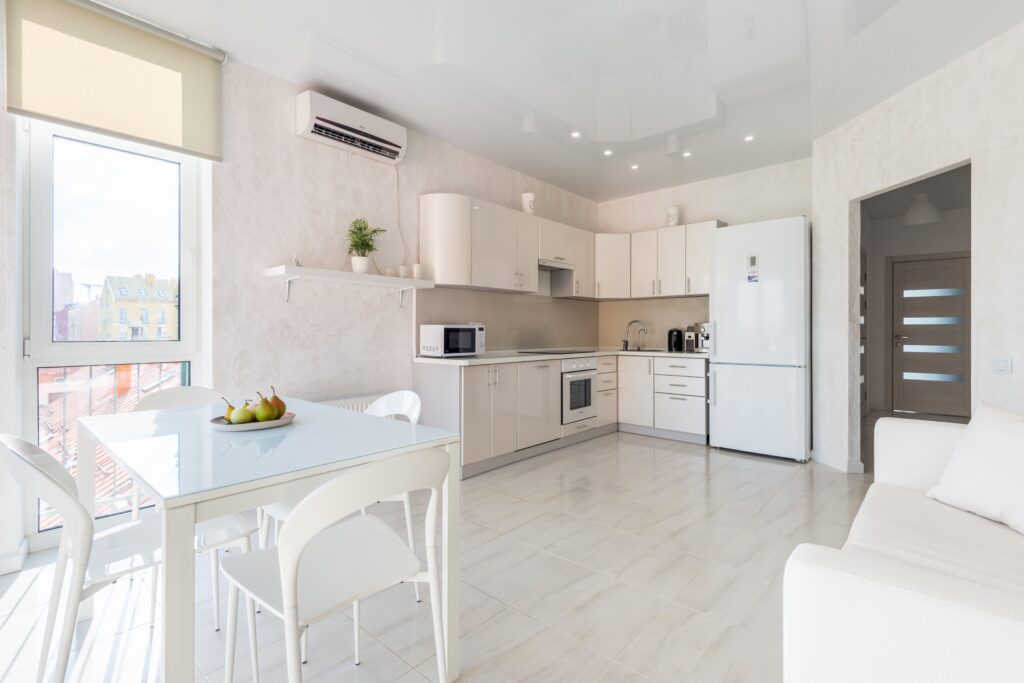
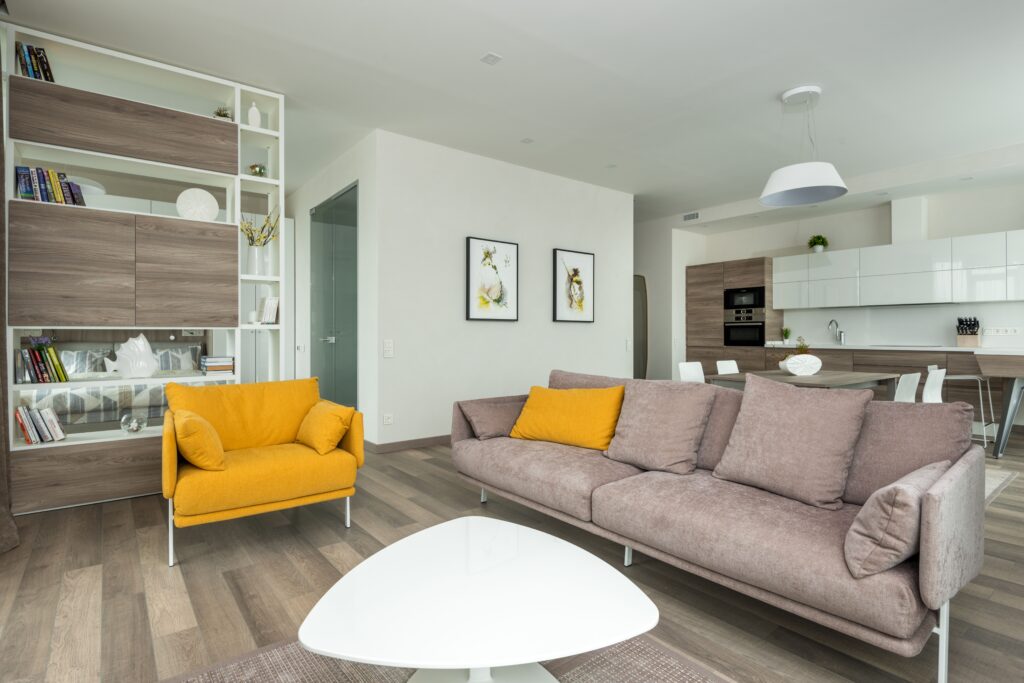
The color palette that produces the most consistent space-expanding effect uses warm whites, soft creams, pale grays, and light greiges — neutral tones that reflect natural light throughout the room rather than absorbing it at the wall surface. The key word is warm — cool whites and blue-toned grays can feel clinical and constricting in small spaces while warm-toned neutrals feel open and inviting.
Painting the ceiling the same color as the walls — or a slightly lighter shade — removes the visual boundary between wall and ceiling that standard white-ceiling-different-colored-walls combinations create. This ceiling-to-wall color continuity makes the room feel taller and more volumetric rather than the boxed-in feeling that a sharply contrasting ceiling produces in a low-ceilinged apartment.
If you rent and cannot paint — removable wallpaper in light tones, large light-colored art pieces that cover significant wall area, and light-toned textiles on sofas and chairs together approximate the effect of light wall color without any permanent modification.
Tip 2: Use Mirrors Strategically and Generously
Mirrors are the single most powerful space-expanding tool available to apartment dwellers — and most people dramatically underuse them. A strategically placed large mirror does not just reflect what is in front of it. It creates the visual impression of an additional room beyond the wall — the doubled apparent depth that fools the eye into perceiving more space than actually exists.
The placement that produces the most dramatic space-expanding effect positions a large mirror on the wall directly opposite a window. This placement reflects the window’s natural light back across the room, doubles the apparent light level, and creates the impression of a second window in the reflected wall — making a naturally bright room feel twice as bright and a naturally dim room feel significantly more open than its window situation actually produces.
Floor-to-ceiling mirrors or very large format mirrors — leaned against a wall or properly mounted — produce more spatial expansion than multiple small mirrors of equivalent total reflective area. The continuous large reflection creates an uninterrupted depth impression while a collection of small mirrors creates a decorative effect without the same spatial illusion.
Mirrored furniture — side tables with mirrored surfaces, mirrored console tables, furniture with reflective elements — extends the mirror effect to horizontal surfaces and contributes to the overall light reflection throughout the room without requiring dedicated mirror wall space.
Tip 3: Choose Furniture That is Scaled to Your Space
The single most common small apartment decorating mistake is furniture that is too large for the room. The oversized sofa that seats eight in a living room designed for four. The massive dining table that seats six in a space where four is the realistic maximum. The king bed that leaves eighteen inches of clearance on each side in a bedroom where a queen would leave a comfortable thirty.
Oversized furniture in a small room does not make the room feel cozy — it makes it feel cluttered and confined. Right-sized furniture for the actual dimensions of the room feels intentional and proportional and allows the floor space visibility that makes rooms feel open.
The practical approach is to measure your space before purchasing any furniture and compare dimensions to furniture specifications rather than trusting visual impressions of furniture on showroom floors where surrounding space makes all furniture appear smaller than it will in your apartment. Floor tape outlines of furniture dimensions on your apartment floor before purchasing produces the accurate sense of scale that prevents the oversized furniture mistake.
Furniture with legs rather than floor-level bases creates the impression of more floor space because you can see the floor beneath the furniture — the visual floor continuity that legless floor-level sofas and beds interrupt. Sofas and chairs on visible legs, bed frames with clearance beneath, and side tables on slender legs all contribute to the perception of more floor area than the same furniture without visible leg clearance would produce.
Tip 4: Embrace Vertical Space With Tall Storage
Most apartment dwellers use the floor space and low surface space of their apartment and leave the vertical space between eye level and the ceiling almost completely empty — the significant volume of visual and functional space that vertical thinking converts from unused to purposeful.
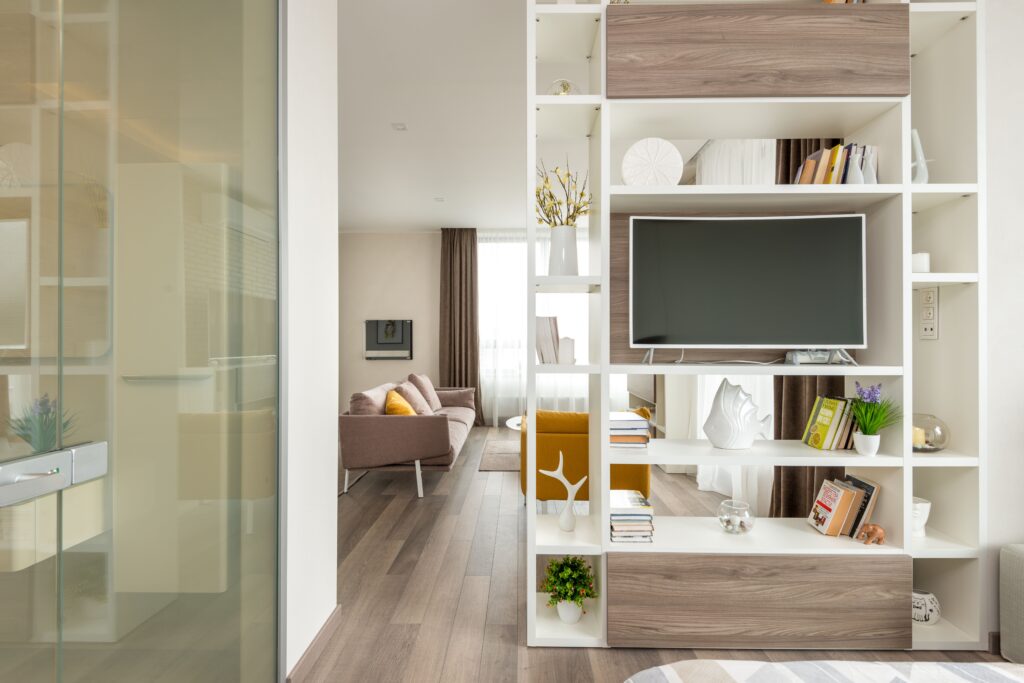
Tall bookshelves that extend toward the ceiling draw the eye upward and create the impression of height — the vertical movement that makes low-ceilinged rooms feel taller than their measured dimensions. A bookshelf that reaches to eight feet in an eight-foot-ceiling room removes the visual boundary between furniture scale and ceiling height that produces the sense of ceiling closeness that low-ceilinged rooms often create.
Curtain rods mounted at ceiling height rather than just above the window frame make windows appear dramatically taller than they are — the floor-to-ceiling curtain that implies a floor-to-ceiling window beneath it and that contributes to the vertical space impression that makes rooms feel larger overall.
Stacked storage that builds upward rather than spreading outward uses the vertical space that floor-spreading alternatives waste while actually providing more storage capacity in less floor footprint — the organizational approach and the spatial approach working together rather than trading off against each other.
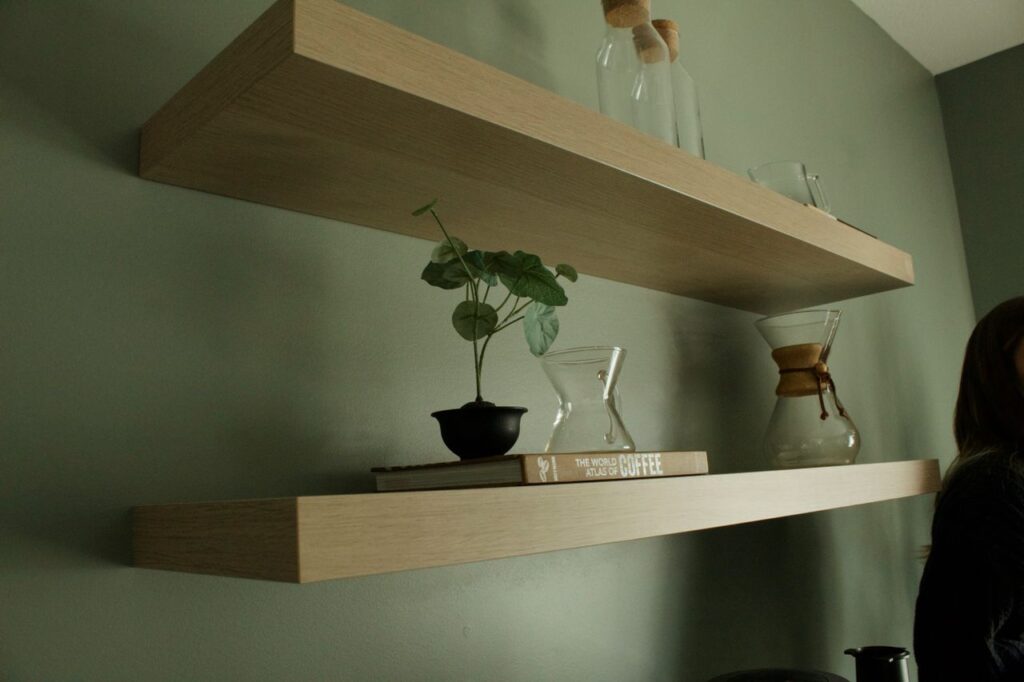
All design tips in this guide work within standard rental apartment constraints — no permanent structural modification required. For the wall-mounted storage that implements the vertical thinking approach while adding genuine organizational function check out our complete guide to the best floating shelves for apartments under $50 — the rental-friendly wall storage that adds visual height and organized storage simultaneously.
Tip 5: Keep Floors as Clear as Possible
The amount of visible floor space in a room is one of the most powerful determinants of how spacious the room feels — more than wall color, more than furniture size, more than lighting in many cases. A room where you can see a significant continuous expanse of floor feels fundamentally more open than a room where the floor is cluttered with furniture, objects, and storage items regardless of the room’s actual square footage.
This means ruthless floor clearing is one of the highest-return space-expanding investments available. Everything currently on the floor that does not need to be on the floor — the storage boxes that could go under the bed, the shoes that could go on a wall-mounted rack, the items that have accumulated without designated homes — creates the visual density that makes small rooms feel smaller.
Large rugs that define seating zones create the impression of more floor space than a bare floor or multiple small rugs — the counterintuitive effect where one large continuous rug makes the floor appear larger by providing a single visual surface rather than the interrupted floor plane that multiple rugs or bare floor mixed with rugs creates. The large rug should be large enough that at least the front legs of all seating furniture sit on it — the floating furniture effect of a rug too small for the furniture grouping makes both the rug and the furniture appear smaller and the room appear more cramped.
Tip 6: Create a Cohesive Color Story Throughout
Visual complexity makes spaces feel smaller. Visual coherence makes spaces feel larger. The apartment where every room, every piece of furniture, and every accessory follows a consistent color palette feels more spacious than the same apartment furnished with an equal quantity of items in a visually chaotic mix of competing colors.
A three-color palette applied consistently throughout the apartment — one dominant neutral, one secondary accent, one complementary accent — creates the visual flow that allows the eye to move through the space without stopping at every point of color contrast. This uninterrupted visual movement makes the space feel continuous and therefore larger than the same space where visual stops at every color transition make the eye work harder to navigate from one element to the next.
This color cohesion applies specifically to large surface areas — sofas, rugs, curtains, and bedding — where a single strongly contrasting item can visually divide a room and reduce its apparent size. When the large-surface elements share a color family the room reads as one cohesive space rather than a collection of competing zones.
Tip 7: Let in as Much Natural Light as Possible
Natural light is the most powerful space-expanding resource available in any apartment — and most apartment dwellers inadvertently restrict it through window treatments, furniture placement, and surface choices that absorb rather than distribute it.
The window treatment that lets in maximum light while maintaining privacy is sheer or semi-sheer fabric that diffuses light across the room rather than the blackout or heavy curtains that block light entirely except when deliberately opened. For apartments where privacy concerns make sheer curtains inadequate, bottom-up blinds that cover the lower portion of the window while leaving the upper light-admitting portion clear provide privacy without sacrificing the overhead natural light that sheer alternatives admit throughout the day.
Furniture placement that blocks window light — a large bookshelf in front of a window, a sofa positioned to intercept light before it reaches the room’s interior — reduces the natural light penetration that makes rooms feel open and airy. Positioning furniture to allow light to travel as far into the room as possible from its entry point at the window maximizes the spatial effect of whatever natural light the apartment receives.
Glossy and reflective surfaces — lacquered furniture, metallic accessories, glass-topped tables, polished floor materials — bounce light across the room in ways that matte surfaces absorb. The apartment furnished with a mix of matte and reflective surfaces distributes light more thoroughly than the all-matte equivalent and feels brighter and therefore more spacious throughout the day.
Tip 8: Use Transparent and Visually Light Furniture
Furniture that you can see through — glass-topped tables, acrylic chairs, furniture with open frames and visible floor below — contributes less visual mass to a space than equivalent solid furniture and therefore makes rooms feel less dense and more open.
A glass coffee table in a small living room is one of the most consistently recommended space-expanding furniture choices available — the table that provides the functional surface of a coffee table without the visual mass that a solid wooden alternative adds to the room. The eye passes through the glass table surface to the floor and rug beneath, maintaining the visual floor continuity that makes rooms feel larger.
Acrylic ghost chairs at a dining table produce the same effect — the dining chairs whose transparent material contributes almost no visual mass to the space while providing full seating function. A dining area with four solid wooden chairs around a table feels considerably more visually dense than the same table with four transparent acrylic chairs despite the identical floor footprint of both configurations.
Wire, rattan, and open-frame furniture alternatives provide visual lightness compared to solid closed-panel alternatives — the visual airiness that open structures provide through the negative space visible within and beneath the furniture.
Tip 9: Remove Visual Clutter Ruthlessly and Permanently
Clutter is the fastest way to make a small apartment feel smaller — and the removal of clutter is the fastest way to make it feel bigger. This is perhaps the most obvious point in this guide and simultaneously the most consistently underimplemented one, because clutter removal requires ongoing behavioral commitment rather than a one-time purchase or design decision.
The distinction between organized storage and visual clutter is important here. Organized storage — books on shelves, items in labeled bins, folded clothing in drawers — does not create the visual clutter effect even when the total item count is significant. Visual clutter is the items without homes, the surfaces covered with miscellaneous objects, the floor area occupied by things that do not have designated storage positions. It is the randomness and apparent lack of intention that creates the claustrophobic effect rather than the quantity of possessions per se.
Every surface in a small apartment should follow the intentional placement rule — every object on a surface is there because someone decided it should be there, not because it accumulated without a deliberate choice. The side table with three intentionally chosen objects feels spacious. The same side table covered with whatever happened to land there feels cluttered regardless of the actual object count.
Tip 10: Layer Lighting for Depth and Warmth
The flat, single-overhead-light illumination that most apartments provide as standard makes rooms feel flat, institutional, and often smaller than they are because even overhead light eliminates the shadow and depth variation that layered lighting creates and that the eye interprets as spatial complexity.
Layered lighting — a combination of overhead ambient light, floor or table lamps at mid-height, and accent lighting at low levels — creates the dimensional depth that makes rooms feel more complex and therefore more spacious. The eye reads the light variation as spatial variation — different areas of the room at different apparent depths — which produces the impression of more visual space than even illumination from a single source provides.
Warm-toned bulbs in the 2700K to 3000K range create the welcoming, spacious-feeling atmosphere that cool-toned blue-white alternatives cannot produce regardless of their brightness level. The bright cool-white overhead light that many apartments use actually makes rooms feel smaller by flattening the visual depth that warm layered light creates through shadow and variation.
Uplighting — floor lamps or wall-mounted lights that direct light upward toward the ceiling — draws the eye upward and makes ceilings feel higher than their measured dimensions, contributing to the vertical expansion that makes rooms feel larger in all dimensions rather than just horizontally.
A small apartment that feels bigger is ultimately a small apartment that has been designed with intention — every element chosen for what it contributes to the space’s visual expansion rather than accumulated without consideration of its spatial effect. For the complete decoration guide that makes your now-larger-feeling apartment genuinely beautiful check out our guide on how to decorate a small apartment on a budget — 10 brilliant tips that work hand in hand with every spatial expansion technique covered here.
Frequently Asked Questions
Q: What is the single most impactful change I can make to make my small apartment feel bigger?
A: If you can only do one thing, add a large mirror on the wall opposite your main window. The combination of light reflection and visual depth illusion produces more immediate and dramatic spatial expansion per dollar spent than any other single intervention available to apartment dwellers working within rental constraints.
Q: Do dark accent walls make a small room feel bigger or smaller?
A: Generally smaller — the dark color on one wall creates the visual advancement effect that makes that wall appear closer and the room appear shorter in that dimension. The exception is a dark accent wall at the far end of a narrow room which can create the impression of additional depth in the length dimension while making the room appear slightly narrower. For most small apartments, avoiding dark accent walls in favor of consistent light-toned colors throughout produces the most consistently effective space-expanding result.
Q: How do I make a small bedroom feel bigger without removing furniture I need?
A: Mount your bedside storage on the wall rather than using floor-standing nightstands — wall-mounted bedside shelves provide the same function with zero floor footprint. Use under-bed storage for items that currently occupy floor space. Mount your curtains at ceiling height. Use a mirror on the back of the bedroom door. These four changes together significantly increase the perceived size of a small bedroom without removing any functional furniture.
Q: Can plants make a small apartment feel bigger?
A: Yes — strategically placed plants contribute to the feeling of spaciousness through the biophilic effect that natural elements produce on the perception of a space. Tall plants in corners fill vertical space and draw the eye upward. Trailing plants on shelves and hanging plants add visual interest without consuming floor space. The key is choosing plants whose scale suits the space — a single large statement plant in a corner contributes more to the spatial feeling than many small plants scattered on every surface.
Q: Does minimalism mean I have to give up my personality to make my apartment feel bigger?
A: No — intentional is more accurate than minimal. The apartment that feels biggest is not the one with the fewest possessions but the one where every possession has a deliberate place and purpose. Personality through art, through a curated collection of meaningful objects, through textiles in your chosen colors — all of this is compatible with the spatial expansion principles in this guide when applied with intention rather than accumulated without it.
Conclusion
Making a small apartment feel bigger is not about wishing for more square footage. It is about understanding how the eye and the brain interpret space — how light, color, reflection, scale, and visual flow collectively determine whether a room feels open and airy or cramped and confined — and then applying specific design decisions that consistently shift that perception toward spacious.
Apply these ten tips in whatever combination suits your apartment’s specific constraints and your personal aesthetic. Even three or four of them applied consistently will produce a noticeably different feeling in your space within a weekend. The apartment that felt like it was closing in on you on moving day can feel genuinely open and livable through design decisions that cost far less than a larger apartment ever would.
Explore the complete collection of apartment organization and decoration guides at ApartmentOrganizerHub.com — Apartment Organizer Hub Blogs Page — for practical honest advice on making every apartment feel like home regardless of its square footage.